Back

Defects

Steel defects are imperfections that can affect a material’s surface, internal quality, dimensions, mechanical properties, or performance. They can develop at different stages, from casting to processing to storage. Understanding where defects originate and how they affect the material can help manufacturers identify problems earlier and make better decisions about material selection and processing.

Many defects begin during steel production, where chemistry, inclusions, casting conditions, and rolling practices can influence the finished material. Others may develop during downstream processing or appear as mechanical issues when the steel is processed or put into service.

webinar

Steel Making & Defects

Watch the previously recorded webinar, “Steel Making & Defects”, taught by our very own, Allison Lucak, PE. Learn how defects can develop throughout the steel making process and what they can mean for material performance.

Why do blast furnaces use torpedo cars instead of some other means of transporting the pig iron to the next step?

Torpedo cars are lined with refractory bricks to keep the pig iron at temperature while it’s being delivered to the steelmaking facilities. This allows the torpedo cars to act as a buffer in case the molten pig iron needs to hang out for a bit. An example of this: Cleveland Cliffs Riverdale has a caster but no steelmaking capabilities, and they rely on torpedo cars to bring steel from Indiana Harbor. 12 miles!

Design-wise, torpedo cars are actually quite large, and they are carried via a rail system at the steel mill. The ends are able to rotate, which allows the torpedo car to turn on its side to empty.

Torpedo cars were engineered to withstand the monumental task of transporting extremely heavy loads of molten metal across potentially significant distances.

Integrated mills produce heats about 200-300 tons in size, and mini mill heats are about 90-150 tons.
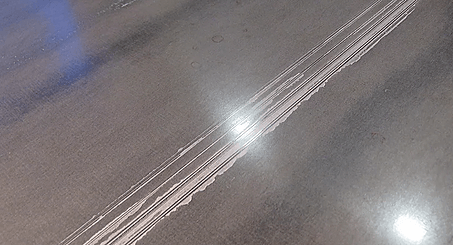
Slivers are more common in certain grades; generally, the harder material is to cast (rich chemistries), the higher the chance is for casting related defects.

Slivers are a casting defect, so hot rolling only affects how they appear (linear and elongated). The hot rolling equivalent to slivers could be scabs, where something is getting pressed into the surface at the hot strip mill.

As briefly touched on in the presentation, casting is an extremely delicate and complicated process. I’m sure there are process variables that increase the propensity for slivers, but as I am not a casting expert,I can’t thoroughly answer your question.

I can say that mold powder getting pressed and entrapped in the surface of the slab is a common cause of slivers, and that sometimes they occur on slabs very early in a casting sequence.

Water management is dependent on the steel mill – some take, use, clean, and then return the water.
Other mills recycle their water by running it through cooling towers, cleaning baths, and then reusing it.
The only water lost during recycling is lost through steam.

Steel mills can use in excess of millions of gallons per hour!

Strength and hardness are most directly affected by carbon content, so soft steels have very low carbon. 1006 is a commonly used “soft” steel.
If the material is thin enough the slit edge will benefit from galvanic protection. As the ratio of the coating thickness to the steel thickness becomes smaller, the likelihood of edge rust increases. Since the coil will eventually be converted into parts by stamping the same hazard exists on the edge produced by stamping
There is no formal definition of laser quality steel. Some mills promote and even brand products as laser quality. The surface cleanliness, chemistry, and residual stress number are few of attributes related to the steel the affect the quality of the laser cut edge. The residual stress is addressed by the manufacturing process. The stresses are created during uncoiling. The most popular techniques for addressing the residual stress are temper pass cut to length, stretch leveling, and tension leveling.
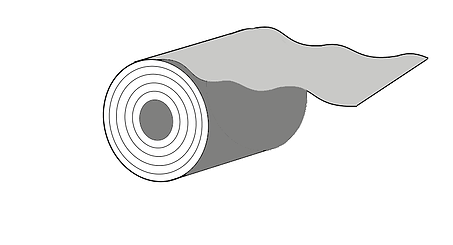
Steel coils have crown, which means that the center of the strip (across the width) is slightly thicker than the edges. When cuts are made that separate the center from the edges, the center cut will build its outer diameter faster that the outside edges. To keep tension on the slitting line, we put cardboard strips to make up for the small difference in diameters.
If the material does not meet the flatness specification after burning, yes, it is rejectable. We do like to thoroughly understand the condition if material is rejected – often this includes a test burn on our own laser tables to eliminate laser burning parameters as a cause.

Typically, lines that decoil do not pull with enough tension to induce crossbow into the material.

In order to induce plastic deformation, the equipment needs to exceed the steel’s yield strength, so inducing shape is grade dependent. Any shape you do see is plastic deformation – elastic deformation is usually tough to detect with the naked eye.

If you’re uncoiling a coil with crossbow, it’s likely already in the coil.

The general camber tolerance is ¼” in 8 feet. This is negotiable depending on the end use.

The CE equation gives an estimation for how likely the material is to form martensite. Not only is carbon the largest factor, but the iron-carbon relationship is well understood. Adding in a bunch of other elements greatly complicates things.

The idea behind the CE equation is to take all of the other elements and relate them to a carbon percentage to determine, as a whole, how easily the chemistry will harden. Chromium, molybdenum,and vanadium play a greater role in hardenability than nickel and copper, so their contribution is larger (a small denominator).

There are a few different version of carbon equivalent equations out there with varying degrees of specificity. The one above is good for general use.

Steel Warehouse has designated inspectors for processing lines. They watch the steel and fill out an inspection report for every coil processed.

The mechanical properties are determined by chemistry and cooling. The coil should have the same chemistry, but slight cooling differences are unavoidable. The very outer and inner laps cool faster,along with the outside edges of the coil.

Because of this, we crop the OD and ID and we do not test for mechanical properties within a few inches of the mill coil edge. Apart from the edges, the width of a plate should have less variation than can be possible down the length of the coil.

Most part design calculates the stress the part will see in service. Stress is force/area.

The majority of the defects in the presentation are surface defects. If a surface defect is severe enough, it could affect the area portion of the force/area equation.

Say you found a really gross sliver that was determined to be 0.020” deep on 0.25” material. The thickness is effectively decreasing to 0.23”, raising the amount of stress the material undergoes.

Given factors of safety, is extremely unlikely that surface defects could compromise the integrity of the part. Huge, substantial defects might, but it’s rare these defects even make it out of the steel mill.

That leaves inclusions and rust.

Inclusions can be concerning because you can’t see them. 100 years ago inclusions were unpredictable and probably caused a few, if not a lot, of catastrophic failures. Today, steelmakers use methods to control inclusions, and the “clean” steel products are both predictable and higher performing.

Rust seems like a benign defect because everyone knows what it is. It’s familiar! The problem with rust
is that it gets worse over time, and will eventually affect the structural integrity of the steel. There are
grades of steel specifically produced to corrode at a slower rate – they’re called weathering steels – but without surface protection, rusting is unavoidable. The one positive aspect of corrosion is that it’s
predictable: parts in service that rust have a lifespan during which they can continue to rust safely (for
example, bridges).

Steel Making and Defects Q&A
Answered by Mick Gugel and Allison Lucak, Steel Warehouse Metallurgists
real people. real expertise.

We're ready to help with solutions you can trust.
