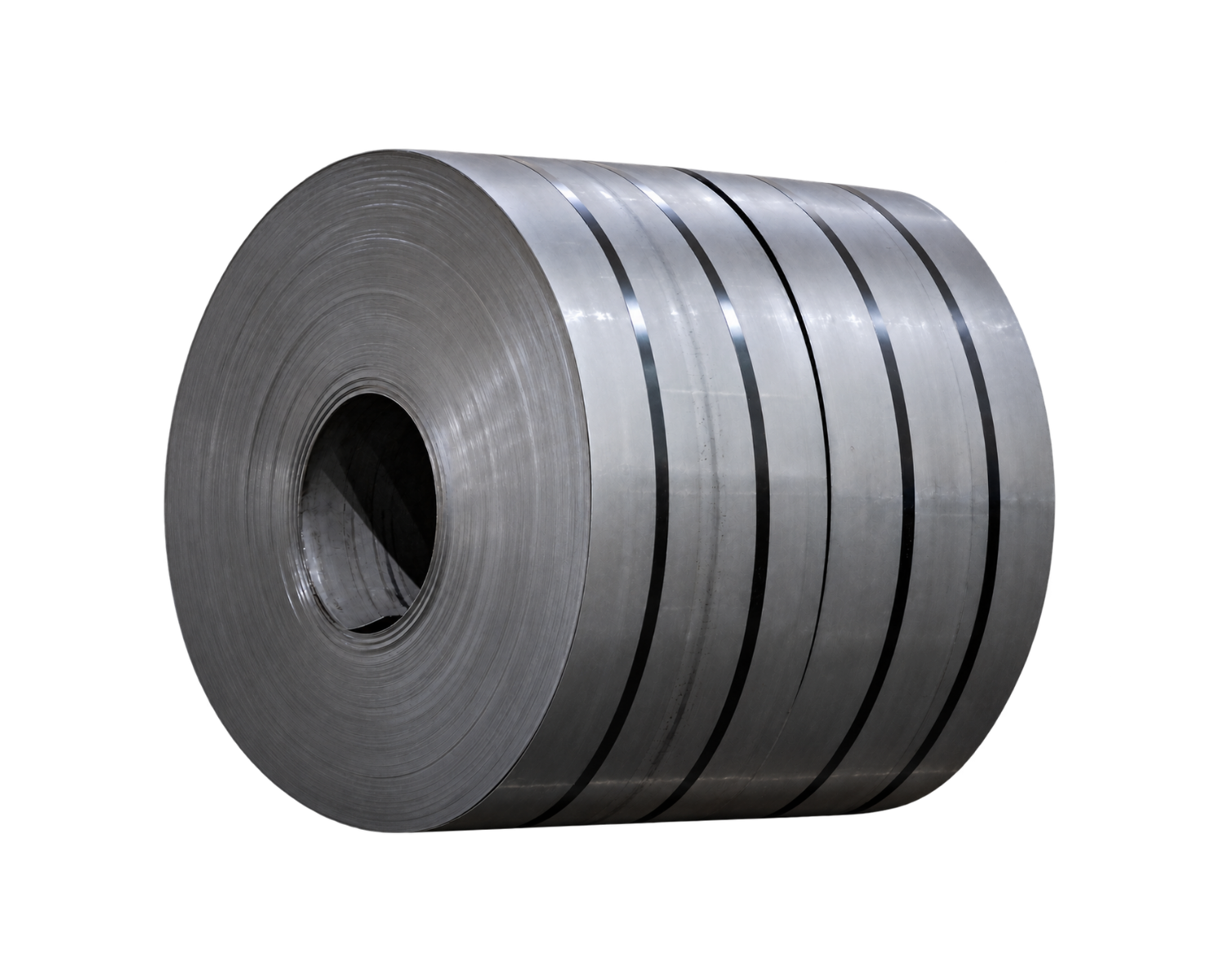
ASTM A1018 is a hot-rolled steel sheet and strip specification that covers heavy-thickness coils. Thicknesses range from under 0.230” up to 1.000”. Thicknesses under 0.230” are covered by ASTM A1011. A1018 applies to coils only, and the coils are not to be converted into plates unless they are tested according to the test protocol specified in ASTM A6. This includes tensile testing a head sample and a middle sample taken from the coil. Once converted to plate, the material is no longer governed by A1018 and must be certified to a plate specification.
High-Strength Low Alloy Steel with Improved Formability (HSLAS-F)
HSLA steel with improved formability and inclusion shape control.
Grade 50
Grade 60
Grade 70
Grade 80
Structural Steel A
Furnished to a chemical composition. Mechanical properties are nonmandatory. Designed for improved forming compared to Commercial Steel.
Grade 30
Grade 33
Grade 36B
Grade 40
High-Strength Low-Alloy Steel (HSLAS)
Furnished to a chemical composition and defined mechanical properties. HSLA steels contain strengthening microalloys (niobium, vanadium, titanium) singly or in combination.
Grade 45
Grade 50
Grade 55
Grade 60
Grade 65
Grade 70
Ultra-High Strength Steel (UHSS)
UHSS steel has increased strength compared to HSLA steel.
Grade 90
Grade 100
Deep Drawing Steel (DDS)
Furnished to a chemical composition. Mechanical properties are nonmandatory. Designed for improved forming compared to Commercial Steel.
DS Type A
DS Type B
1006
1006A
A Yield strength, tensile strength, and elongation guaranteed in the longitudinal direction.
B Grade designation has Type 1 and Type 2
C Grade designation has Class 1 and Class 2
ASTM A1018 Characteristics
Property
specification
Defined Sizes
ASTM A1018 material is defined from 0.230” to 1”.
For plate specifications, see ASTM A656 or ASTM A572.
Ease of Fabrication
ASTM A1018 covers a wide range of grades with a large variation in properties.
Weldability
A material’s carbon equivalency (CEV) indicates the propensity to harden and crack after welding. CEV is calculated using chemistry, so while specific heats of steel will have unique CEVs, general calculations can be made using the chemical limits outlined in A1018. Please Ask an Expert for more information.
Increased carbon content is associated with increased hardenability, leading to the risk of cracking after welding. In this specification, HSLAS steel are available in two classes, Class 1 and Class 2. Class 1 carbon maximums range from 0.22% to 0.26% (grade dependent), and Class 2 carbon maximums are 0.15% across all available grades. Because of this, Class 2 HSLAS steels will generally be easier to weld.
Richer chemistries increase the CEV, so stronger grades require more welding finesse.
Steel Warehouse can limit carbon contents to improve thermal cutting, formability, and welding performance.
Thermal Cutting
Laser and plasma cutting is similar to weldability in terms of the heated cut edge hardening and cracking.
Bendability
High-Strength Low Alloy (HSLAS), High-Strength Low Alloy with Improved Formability (HSLAS-F), and Ultra-High Strength Steels (UHSS) have suggested minimum bend radii that guarantee crack-free cold bending.
Grade popularity makes sourcing easier – steel mills may require heat-sized orders for grades that are not often produced. HSLAS-F grade 50 is one of the most utilized grades defined in ASTM A1018.
Steel Warehouse sources steel coils as A1018, but once the material has been converted into plate the material requires certification to a plate specification. Two plate specifications commonly used for this are ASTM A656 and ASTM A572. Please use the Ask an Expert feature for more information.