

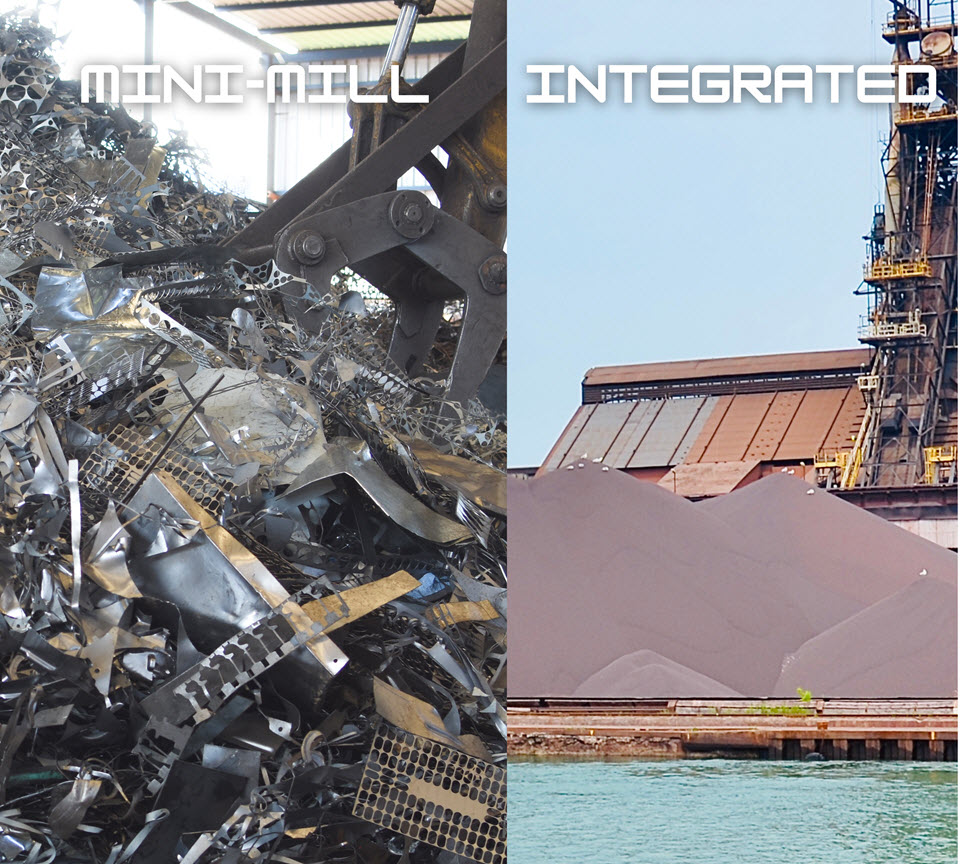
The creation of the mini mill brought flexibility to the steel market. Melting scrap instead of consuming raw materials allowed for reduced capital requirements, less dependency on site location, and operational ease starting and idling the furnaces.
But the question is: how do the steel products of mini mills stack up against the products of integrated mills?
Historically there have been distinct differences between minis and integrated mills, but advancements in the market have driven mini mills to close the gap. Developments in the automotive and line pipe industries have pushed steel mills to develop advanced grades, and mini mills have been forced to either address their differences or miss out on market participation.
Chemistry
Integrated steel has the reputation for being the “clean” steel. Because integrated mills start the steelmaking process with natural resources, they have complete control over the final composition of their steel. Their operations also frequently include vacuum degassing, which removes dissolved gases and further refines the steel.
Mini mill steelmaking begins with melting scrap. The original composition of the scrap constrains the final composition of the steel, as some elements cannot easily be removed once they are added. The introduction of direct-reduced iron (DRI) offers mini mills an impurity-free substrate for steelmaking. Vacuum degassing, previously associated exclusively with integrated mills, and precise wire-fed alloy additions have found their way into the mini mill steelmaking process. DRI supplementations and processing improvements allow mini mills to produce steel with a refined chemistry competitive with that of an integrated mill.
Slab Thickness
Traditional casting at an integrated mill produces slabs around 7-12 inches thick. This allows for very high reduction ratios when the slab is rolled into a coil at the hot strip mill. Most defects present on the casted slab get “rolled out” during this process, producing a coil free from major defects. Since their creation, mini mills have produced slabs around 2-4 inches thick. Thin slabs are not given the same luxury in “rolling out” defects – a defect-free coil requires minimal slab defects. Recently, there have been enhancements to this casting process. America will see its first thick slab caster at a mini mill, which is set to produce 8-12 inch slabs in 2022.
For more information about steel mills, please reach out to the Technical Group using the Ask an Expert feature.

Written By:
Allison Lucak, P.E.
Metallurgist