
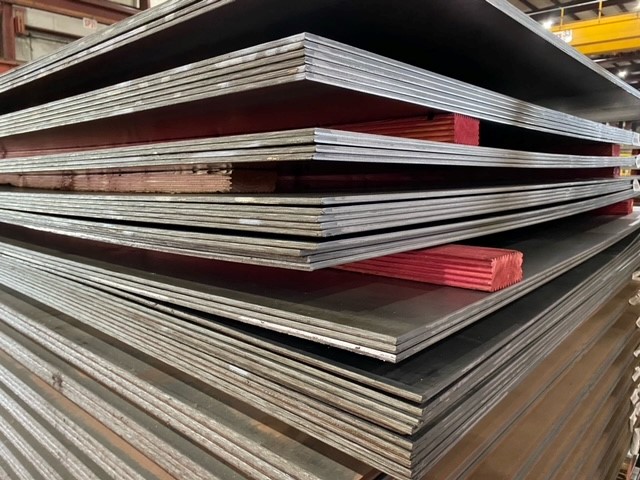
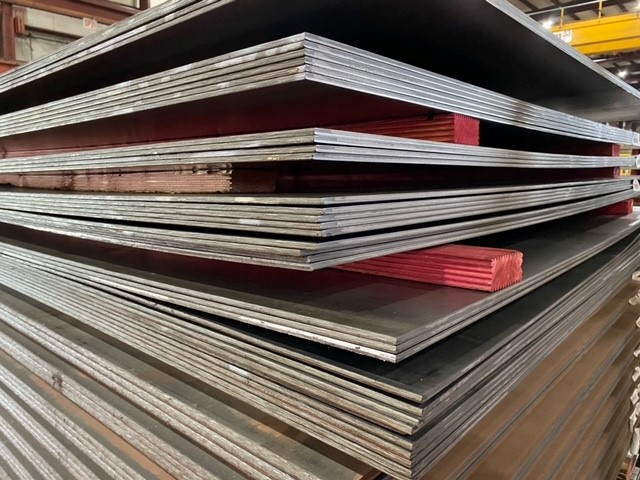
Flat rolled steel products can be separated into two general categories: plate mill products and hot strip mill products (coils). The processes to create these products have differences, but fundamentally the same principles drive production. Heating and cooling is used to obtain a specific microstructure, which gives steel its mechanical properties.
Plate Mill Products
(often referred to as discrete plate)
Conventional plate mills have operational setups similar to this basic process flow:
Reheat Furnance → Mill Stand → Cooling → Cooling Bed → Heat Treatment
Plate mills may also have hot plate leveling, cold plate leveling, or both, and often include a stand for edging.
For material over 1” thick, discrete plate mills are currently the only option. There is limited availability for hot strip mill products over 96” wide. Some plate mills have cross-rolling capabilities, which allows them to turn the slab 90 degrees during rolling, increasing the width.
Hot Strip Mill Products
Hot strip mills follow this general process flow:
Reheat Furnice → Roughing Stand → Finishing Mill → Cooling → Coiling
Mini mills frequently charge slabs directly into the hot strip mill, bypassing the need for a reheat furnace.
Coiling limits the thickness available from a hot strip mill; the thickest coils offered today are 1” thick. Coil products out-compete discrete plate with decreasing thickness, and reliably produce light thickness with good shape.
Combo: The Steckel Mill
A Steckel mill allows for more flexibility (it can produce plates or coils) and low conversion costs, but can sacrifice high capacities. This type of mill uses a reversing stand to pass a slab back and forth, often into two coil boxes at either end to retain heat.
Reheat Furnance → Reversing Stand → Cooling → Coiling/Cooling Bed
General Discussion
Historically, thickness and grades that were exclusively produced as discrete plate can now be produced as coils. Specifications written for discrete plate may have requirements that do not apply to coil products.
Process Path
Going back to the discrete plate process:
Reheat Furnace → Mill Stant → Cooling → Cooling Bed → Heat Treatment
Depending on the grade, discrete plate may require a heat treatment to obtain certain mechanical properties. This heat treatment is also called quench and temper (Q&T). Remember – the mills are using heating and cooling to obtain a certain microstructure. Heating allows the atoms in the steel to diffuse, and the microstructure will naturally go to its lowest energy state.
Heating → Soft,Ductile
Quenching, or rapid cooling, stops diffusion and locks in a microstructure. Sometimes the locked-in microstructure is a higher energy state, like martensite.
Quenching → Strong,Brittle
As soon as the atoms in the higher energy state are allowed to diffuse (heated), they will move to a lower energy state. A strong, brittle microstructure will turn into a soft, ductile microstructure. This can be done to varying degrees; there are many types of heat treatments for many mechanical property requirements.
Many specifications written for discrete plate require heat treatment. But looking back to the coil production process:
Reheat Furnace → Roughing Stand → Finishing Mill → Cooling → Coiling
…There is no heat treatment. The cooling stands “quench” the steel to its final microstructure. That’s not say coils can’t be heat treated – they can – but specifications written for specific heat treatments to produce certain properties may only apply to discrete plate.
Coiling Hot → Soft,Ductile
Coiling the hot strip mill product at an elevated temperature will produce a soft formable product.
Coiling Cold → Strong,Brittle
Coiling the hot strip mill product at a low temperature will result in a very strong material often with properties similar to the quench and tempered plate mill products, but without the extra processing steps.
In summary, discrete plate and coils are two roads to the same destination. Discrete plates can be wider and thicker, and coils may offer improved shape and surface. Once a coil has been cut to length, it can be used in the same applications as discrete plate. Metallurgy, chemistry and rate of cooling is much more important than whether the steel was quench and tempered or cooled on a hot strip mill.

Written By:
Allison Lucak, P.E.
Metallurgist